Every dance is unique and unrepeatable. Rhythm, movement, emotion — Caribbean dances give dancers a pleasure like no other. And if you ever get the chance to try dancing even one of them, take it! Try it, feel it, learn it. A new world will open up before you, one you’ll want to return to again and again.
Bachata
It was the music. It pulled me in and called me toward it. I was standing in a dark alley, in a country still new to me. I wanted to know and feel everything. Stepping carefully, I walked toward the sound.
The melody was tender, filled with sadness — the kind of sadness that settles in the heart after a parting. At last I saw people. They were couples. Their bodies were closely intertwined, moving slowly and smoothly to the spellbinding music.
“One, two, three, four… kick. One, two, three, four… kick.” “Ba-cha-ta,” someone whispered softly in my ear. I turned around, and his hands had already settled on my waist. I let go of my thoughts and trusted my partner. “I don’t know how,” I murmured quietly. “You don’t need to do anything. Just listen to my body and move with it. I’ll count. On the fourth beat, your hip goes up. Smoothly, as if you want to gently brush against someone.”
That’s how I met BACHATA. More than 8 years have passed since that evening, and bachata has become one of the symbols of the Dominican Republic for me.
The dance’s name comes from the Spanish bachata or cumbachata — informal gatherings of the poor, always with plenty of drinking. These get-togethers were held in house courtyards or simply out in the street, in the shade of trees. The musical style and dance of the same name were born right here, in the Dominican Republic, and spread widely across the Caribbean.
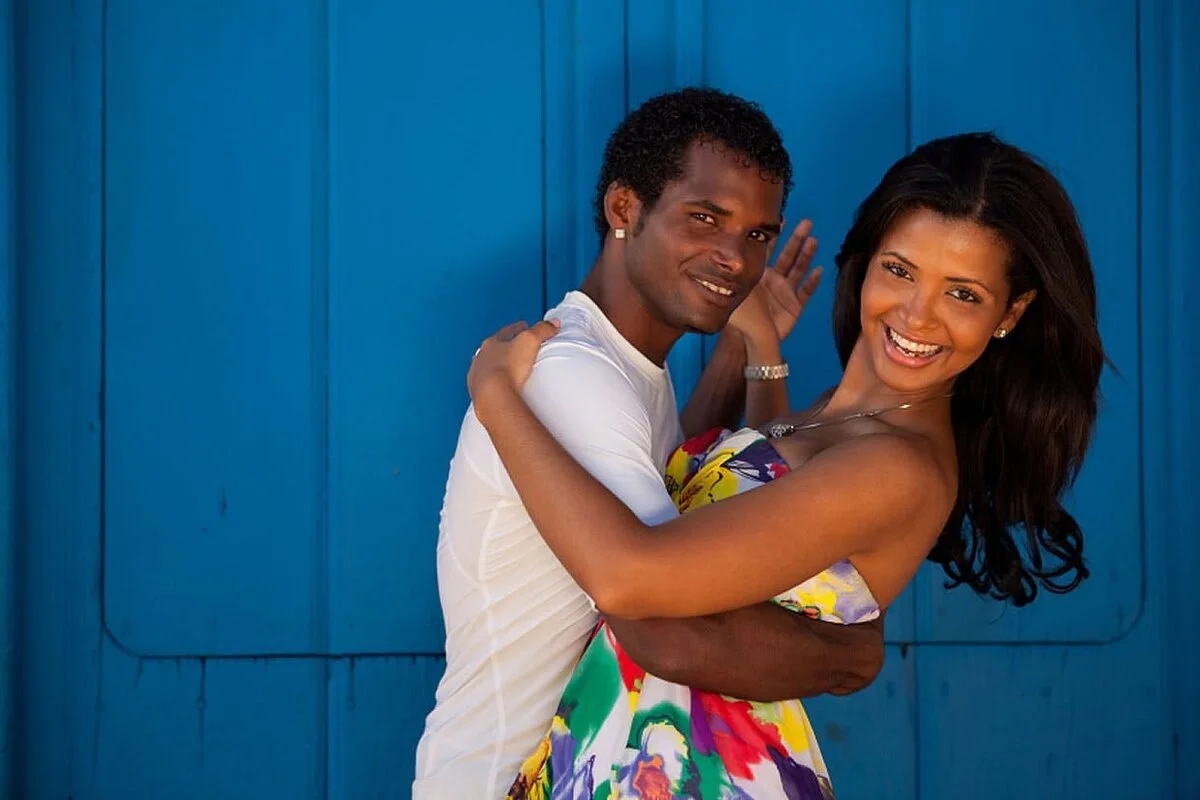
Musically, bachata is hard to confuse with other dances. It’s danced in 4 counts, with the accent on the last one. The technique is simple: four side steps, and on the accented beat, a spiral hip movement upward. Bachata is always danced in closed position, with close contact. There are very few turns, but plenty of side walks and “tossing” the woman from side to side.
“Musica de amargue” — music of bitterness, lyrics about unrequited love, a longing to stretch out every moment together — all of this makes bachata an extraordinarily sensual dance.
Salsa
Another popular dance danced across the whole country is SALSA. Salsa comes from the Spanish word for “sauce.” This dance tastes spicy and zesty, like chili sauce. Salsa’s temperament is a spark of expression, a palette of accents, and a fairly fast tempo.
There are several stories behind the name “salsa.” According to one, a band playing Cuban music once performed at a small club in Miami. They got the crowd so fired up that everyone started shouting “Salsa! Salsa!” — meaning the music was as spicy and hot as the sauce served at that venue.
According to another version, the name traces back to a dance popular at the turn of the century called “Echale Salsita.” In the late ’60s in the US, a concert took place where Latin American musicians introduced a “new boogaloo rhythm” — nothing other than Cuban son mixed with merengue, cha-cha-cha, mambo, and boogie-woogie. Watching people from every corner of America dance to this new rhythm, Tito Puente reportedly said, “Esto es una gran salsa!” — literally, “This is a great sauce!” The great sonero meant that, just like in a sauce, various ingredients had mixed together in this rhythm, giving birth to an especially “tasty” blend.
Whichever version you choose, they all agree on one thing: salsa is a mix of different Latin American styles and rhythms.
As for the dance figures characteristic of salsa, it’s worth noting that the dance has changed over the years. In the early ’20s, for example, salsa resembled a slower version of rumba, while in the ’40s in New York, jazz and blues influences reshaped the dance, giving it its basic step.
Technically, salsa isn’t complicated. What matters most is expressing your emotions and feelings openly. There’s intrigue here, courtship, rejection. Salsa is like a small story between two people, brought to life in dance. And even though the figures repeat, something unique and unrepeatable is born with every new partner.
Son
Since salsa’s birthplace is Cuba, Cuban son can be considered one of its variants.
The world learned of this dance back in the 1930s, and it can be considered the “grandfather” of modern salsa, both as a dance and as music.
Son is a couple’s dance with varied rhythmic patterns. Its main feature is that it’s danced on the contratiempo, starting the movement on counts four and eight. Son resembles a slowed-down version of salsa. Musically, it combines Spanish folk romance with African rhythms.
According to one version, the dance’s name traces back to the Latin “sonare” — to play, to sing. According to another, this was the name of a dance form in 18th-century Mexico.
The technique is dominated by chassé steps, pauses, and turns, and partners touch each other relatively little.
There are four main variants of Son:
Montuno — a rural sub-style, freer than the rest. Guaracha — fast, with a distinctive basic step: a criss-cross with weight transfer between the feet. Changüí — a springy step. Tradicional — an elegant, slow Son.
Merengue
Have you ever tried those airy white sweets made from egg whites? Yes, exactly — those are called meringues. Delicate, crunchy little treats that have won over sweet tooths across the world.
Is it pure coincidence that a dance born in the Dominican Republic shares almost the same name, differing by just one letter?
Translated from Spanish, “merengue” means “meringue,” and “meringue” in turn traces back to French, meaning “kiss.”
Born in the Dominican Republic, this extraordinarily sensual, fiery dance is also called MERENGUE. It draws people in with its temperament and expressiveness. And the movements are so light they resemble a meringue melting in your mouth.
That said, its origin is the subject of much debate. Here are just the most interesting stories about how merengue appeared in the Dominican Republic.
In 1844, a melody rang out in honor of the Dominican army’s victory over Haitian forces. It’s said to have inspired the birth of the dance in the province of Cibao. Rumor has it this cheerful tune mocked a Dominican regiment commander who fled the battlefield. By the mid-19th century, this melody had become beloved and popular, replacing other rhythms of the time.
According to another version, the name traces back to a figure in the Cuban dance “Upa Habanera.”
However, the most plausible story involves the enslaved people working sugarcane plantations. According to it, workers were shackled to one another to prevent escape, which forced them to drag one leg. To keep the enslaved workers moving at a set pace, an overseer would strike them with a rod to set the tempo.
Technically, merengue is a very rhythmic dance. And this rhythm can be powerful — history tells us that, in the Dominican Republic, the political slogans of the notorious dictator Trujillo were once set to merengue rhythms.
As a dance, merengue uses plenty of figures and flourishes. Circular hip movements, body rotations, and fast shoulder movements are especially common. Many of these trace back to the dance’s folk origins.
Reggaeton
Reggaeton first emerged in the 1970s, when Jamaican immigrants brought a new musical style — reggae — to the US. It blended elements of different cultures: hip-hop, rap, techno.
Reggaeton is such a dynamic, captivating dance that it’s hard to stand still once you hear its rhythms. The movements are often so bold and unrestrained that some might even find them vulgar. It’s no accident that US authorities strictly banned the style’s growth at one point — the dance’s movements clashed with the government’s moral standards, and any attempt to organize reggaeton discos was firmly shut down by police.
The name comes from the musical style “reggae” plus the augmentative suffix “-ton.” Reggae, in turn, comes from the term “pere-pere,” meaning “rags” or “torn clothing” — a first clue to understanding reggaeton’s style and character.
It can be danced solo or as a couple. Partner reggaeton is set apart as its own category, drawing in elements of salsa and bachata. The most attention goes to the legs and stomach — legs and hips are in constant motion. Movements of the arms, shoulders, and whole body are added on top. The result is a bold, beautiful dance.
A particularly hypersexual and intimate sub-style of reggaeton is Perreo (from the Spanish “perro” — dog). The female partner stands with her back to her partner, performing various hip rolls (winding) and shaking movements.
It’s worth noting that Dominican reggaeton is the youngest dance style, and one that has won special love and popularity.