The Dominican Republic produces more cigars than any other country in the world: every year it exports 350 million “puros” — the term most often used for cigars in Spanish.
The history of cigars traces back to the Bahamas. From there, in the late 15th century, Rodrigo de Jerez, a member of Christopher Columbus’s expedition, brought the first tobacco leaves to Europe. Cuba later became the leading cigar producer, but after the 1962 US embargo against the island, the Dominican Republic took the lead. Over 50 years, the country’s cigar industry grew by leaps and bounds, as most major Cuban tobacco companies — Davidoff, Arturo Fuente, The Griffin’s, Santa Damiana, Ashton — relocated their plantations, factories, and even Cuban specialists here. General Cigar and Consolidated Cigar Holdings (now Altadis), today the largest producers of premium cigars, also set up shop here.
Most Dominican tobacco plantations are located in the valleys of Santiago and Cibao, with the land around the Yaque del Norte river considered the finest. Tobacco is grown for about 4 months, and the leaves are harvested just before flowering — it’s believed that once the first bud opens, the nicotine concentration in the plant drops sharply. The lower leaves, called volado, are used as the wrapper (capa). The middle leaves (seco) form the intermediate layer (capote). The filler (bonche) consists, depending on the producer, either only of the upper leaves (ligero) or of all three levels. The bonche recipe is kept secret, since it’s exactly what defines each brand’s unique puro flavor.
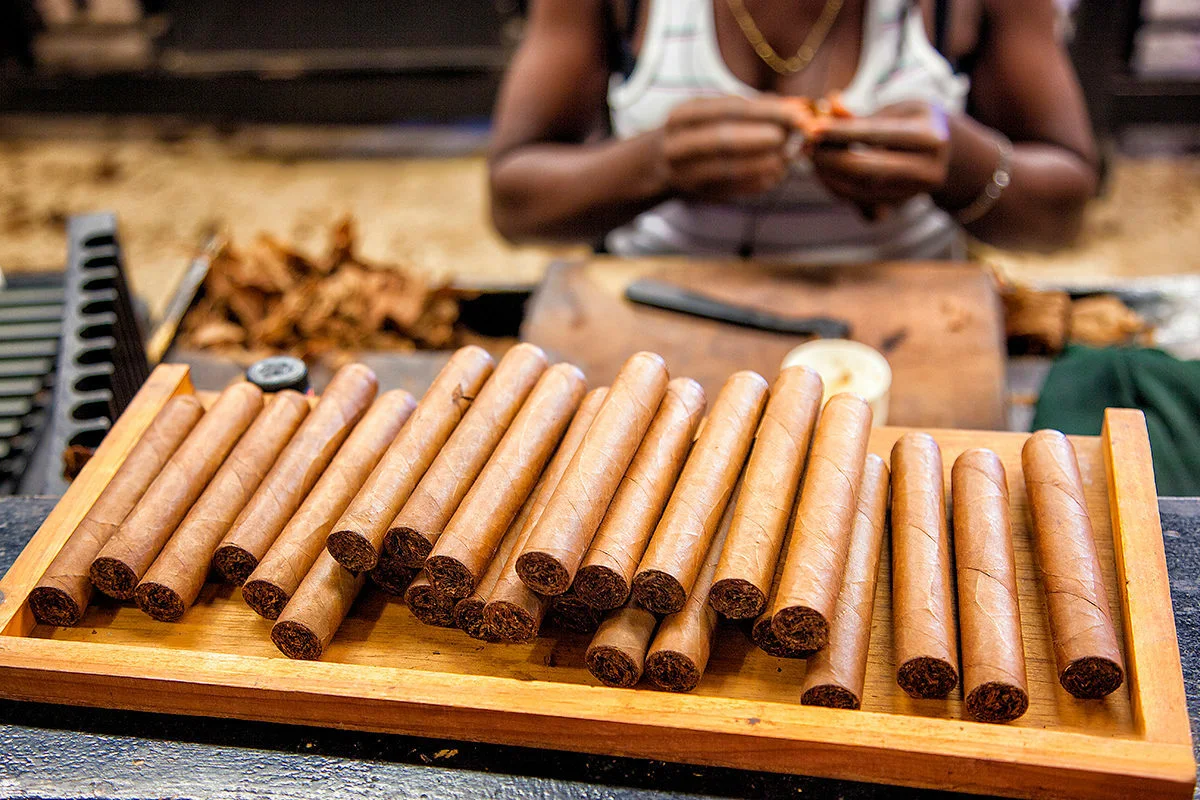
The tobacco leaves are dried for a month or two, then go through a fermentation process lasting one to four months. The leaves are then sorted again. Undamaged ones are set aside for premium hand-rolled cigars, while the rest go toward cigarettes and machine-rolled cigars. In the Dominican Republic, cigar leaves are traditionally stacked in wooden crates, where they undergo a “soft fermentation” that can last up to several years. In the final stage, a team of three people, called torcedores or rollers, roll the cigar. A plant-based glue made from tragacanth gum attaches the cap — the part smokers later cut off with a guillotine cutter.
The price of a cigar depends on many factors, from the soil and climate to the amount of time invested, the volume of manual labor, and the skill of the people involved in making it. On the streets of the Dominican Republic, cigars can be bought for 5 euros; in collectible cigar shops, they sell for several thousand euros. To avoid buying a fake:
-
Check the box or tube. It’s worth finding out in advance exactly how the manufacturer packages its cigars — wood, metal, glass, or plastic.
-
Look at the logos and design details. The most commonly faked brand is COHIBA. Keep in mind there are two brands with the same name: the Cuban one, in a black-and-yellow color scheme, and the Dominican one, with black letters and a red inner outline on the “O.”
-
Pay attention to the extra packaging elements: is there tissue paper and cedar strips to help the cigar age, and are there authenticity seals and stamps?
-
Compare the cigars. They should be the same size, shape, and color.
-
Take a close look at each puro: is the wrapper leaf smooth and consistent, are there no green tobacco flecks in the filler, and is the cigar’s cut even?
In upcoming posts we’ll tell you about the most famous Dominican cigar brands — in the meantime, feel free to ask us any questions.